Because Mad Men (the television show) is about the late 1950s/1960s as is The Conquest of Cool and because we're paying some attention to various genres of re-presenting the past, I included the show in our syllabus. That decision also obligated me to watch some episodes, read about the show, and think about it beyond mere plot summary. Today in class we watched a few clips and included my former teaching partner, Chris Galdieri, in the conversation via skype from his new post at St. Anselm College. The technology was a little clunky, but fun for the novelty.
Chris pushed us to think about a notion Don Draper introduces in his pitch to Eastman-Kodak, namely that nostalgia is related to the pain of old wounds. I have checked the etymology; that is not precisely correct, but it will do for our purposes. Since the show has evoked and builds on a sort of nostalgia for the 1960s we can ask what "old wounds" it is exploring. And what sort of portrayal does it provide? Is this a representation intended to probe those wounds or to heal them? Whose wounds, the old wounds the characters feel or the wounds they inflict upon their descendants, literal and generational?
One of the authors I read, J. M. Tyree, pointed out that the creator of the show, like the Coen brothers who wrote A Serious Man set in the approximately the same pre-1968 era, did not live through these years as an adult, if at all. Thus, if the show is indeed returning to old wounds, they have been experienced indirectly. Perhaps, to oversimplify, the children raised according to the precepts of Dr. Spock are exploring the genesis of their own experiences. (Maybe the times are a bit off.) Alan Anderson, an Australian argues that "we" like the show because it portrays a time freer of government regulation in which people may have behaved badly, but they were also held accountable for their behavior. I"m not convinced that the last is true. It seems to me that the show is filled with people being able to hide their deliberate disregard for social norms, though perhaps this is merely an indication of the prevalence of some sort of double standard for public and private behavior. If so, we'd need to pay close attention to how and where that line is drawn.
A blogger who offers detailed and fascinating analysis of the costuming notes that his mother, or the mother of a friend, like the character Peggy Olson was a recently graduated secretary from Brooklyn working in a Manhattan office in precisely these years. She is uninterested in the show and does not find it to provide an accurate portrayal of her experience. No doubt not everyone participated in this "life style" even if the clothes, furniture, cuisine, and other decorative details are on target.
Tyree offers this: "An American paradox is that the much-vaunted Emersonian characteristic of self-reliance dovetails rather nicely with the goals of big business to create a nation of isolated, vulnerable, and greedy selves who can be persuaded that buying products is a form self-expression. . . . then Don Draper and Peggy Olson are emblematic figures in the rise of a funny kind of freedom." Certainly these two characters have wounds and acquire them even as they exercise their freedom. That in itself might be a lesson worth pondering: the exercise of freedom is likely to produce injury as well as pleasure. And a challenge we Americans have not yet met is to tend to the injury, to one's self as well as to others, not only to celebrated the pleasures.
conversing about and with America, Americans, and American Conversations students
Showing posts with label freedom. Show all posts
Wednesday, April 25, 2012
Tuesday, March 13, 2012
Freedom {preposition} religion
This from Bill Moyers on the recent episode regarding contraception, insurance, and Roman Catholic teaching and practice is a fine analysis that hangs on which preposition is inserted between the words freedom and religion. The liveliness of American religion is stimulated in large degree by the tense circumstances generated by inserting both of and from. The first amendment promise of freedom of religion (free exercise) is linked with the promise of freedom from (non-establishment). While the initial scope of this was limited, over the decades we've expanded from the specific legal guarantees to more general cultural expectations that require frequent negotiation. The freedom to exercise (to believe and practice) one's own religion, does depend on freedom from coercion that forces one to subscribe to the beliefs and practices of another religion. While this may seem, to many citizens, obvious in the realm of governmental authority, the rub comes in other arenas, most specifically in "faith-based" institutions such as Roman Catholic hospitals. What Moyers points out about Obama's recent efforts is that the president is offering a plan that preserves the rights of the individual while not forcing the institution to compromise its policies. Would that all similar conflicts about for/from could be so neatly addressed.
Monday, October 4, 2010
Senses and Place
"A tangible sense of place develops in their [Pueblo dwellers] architecture because it is premised on such a powerful sense of belonging to a larger natural whole." Tony Anella, "Learning from the Pueblos," p. 31
"... all the senses were utilized....Everything was touchable, knowable, and accessible." Rina Swentzell, "Conflicting Landscape Values: The Santa Clara Pueblo and Day School, p. 57
These two quotations highlight the close relationship between our physical senses and our psychological or spiritual senses. The aroma of almond cookies in Macao brought me from Asia back to Christmas in Minnesota in a second; immediately I was intensely aware of being away from home, even as I was comforted by the taste of almond in a cookie stamped with a Chinese character rather than in the shape of a Christmas tree.
The shape of the land around us, the type of vegetation, the quality of light: these effect us in ways beyond what we see. This weekend I was on a bus tour of historic churches in southeast Minnesota with a group of historians of Lutheranism. One remarked on the acres and acres of half-harvested crops: "There is a lot of empty out there." Her's was the very opposite response to my initial reaction to a deep, mountain valley. There I sensed, not security, but constraint.
Seeing, smelling, touching, hearing, even tasting are the means by which we perceive our surroundings. From those perceptions we gain a sense of where we are and who we are. Anella quotes Harries: "true freedom is not freedom from constraint, but rather to be constrained only by what one really is, by one's essence." Indeed, who one is, who we are, these identities involve boundaries that do constrain our freedom even as they provide a sense of belonging.
"... all the senses were utilized....Everything was touchable, knowable, and accessible." Rina Swentzell, "Conflicting Landscape Values: The Santa Clara Pueblo and Day School, p. 57
The shape of the land around us, the type of vegetation, the quality of light: these effect us in ways beyond what we see. This weekend I was on a bus tour of historic churches in southeast Minnesota with a group of historians of Lutheranism. One remarked on the acres and acres of half-harvested crops: "There is a lot of empty out there." Her's was the very opposite response to my initial reaction to a deep, mountain valley. There I sensed, not security, but constraint.
Seeing, smelling, touching, hearing, even tasting are the means by which we perceive our surroundings. From those perceptions we gain a sense of where we are and who we are. Anella quotes Harries: "true freedom is not freedom from constraint, but rather to be constrained only by what one really is, by one's essence." Indeed, who one is, who we are, these identities involve boundaries that do constrain our freedom even as they provide a sense of belonging.
Friday, September 17, 2010
Freedom of WHAT religion?
A news story LINK about the interplay of various freedoms and rights in a North Carolina school. This time the issue is not textbooks, but rather a dress code. That code has been interpreted to prohibit a student from wearing her nose ring (really a stud, not a ring) to school, but the student and her mother contend that the nose ring should be allowed as an instance of freedom of religion. Those who heard Prof. Schillinger on minority and majority views of freedom of religion, at the Constitution Day panel, will now hear echoes of his remarks. Is this practice, body piercing, a form of religious expression? Who has authority to decide? At the center of the case is a question about the equal treatment of all religions.
In view of our discussion today in Section A, those students may be interested in the notion of hybrid rights described in this news article. While noting that freedom of expression may be limited in certain settings, the student and her mom argue, with the ACLU, that freedom of religion trumps those limits. The legitimate limits may be analogous to the locational barrier we discussed in class.
From Yahoo News.
In view of our discussion today in Section A, those students may be interested in the notion of hybrid rights described in this news article. While noting that freedom of expression may be limited in certain settings, the student and her mom argue, with the ACLU, that freedom of religion trumps those limits. The legitimate limits may be analogous to the locational barrier we discussed in class.
From Yahoo News.
Wednesday, September 15, 2010
Fighting Freedoms
Today's discussion of Amy Tan's essay, "To Complain is American," and the American Radio Works documentary, "Great Textbook War," pushed me to think more about competing freedoms. This is not quite the same thing as Foner's notion that freedom is a contested concept. Rather, I have in mind situations in which two people's, or groups of people's, freedoms seem to compete or even when one person experiences one freedom limiting another.
In the West Virginia textbook "war" some parents wanted a sort of moral and personal freedom to follow their own beliefs and to decide what their children would learn without an coercion from the school board. At the same time, public education in the USA is intended to prepare students for their responsibilities as citizens who have political freedom. Thus the civic community has a stake in those students' learning.
Matt's introduction of the federally mandated observance of "Constitution Day," elicited some of this same dynamic. Who said, "If the government pays, the government can make regulations?" In order to have access to resources (economic freedom?), the institution, its employees and students submit to a bit of coercion about our programs.
This raises the related, crucial question: What is freedom for? How is it to be used? Tan's essay highlights these questions as she wrestles with the American right to speech, even to complain, the writer's responsibility to speak, and the likely consequences of doing so. She hints at the distinction we have heard in the news about the proposed mosque/community center in Manhattan. While the community has a right to build there, that right does not necessarily make doing so a good idea.
In the West Virginia textbook "war" some parents wanted a sort of moral and personal freedom to follow their own beliefs and to decide what their children would learn without an coercion from the school board. At the same time, public education in the USA is intended to prepare students for their responsibilities as citizens who have political freedom. Thus the civic community has a stake in those students' learning.
Matt's introduction of the federally mandated observance of "Constitution Day," elicited some of this same dynamic. Who said, "If the government pays, the government can make regulations?" In order to have access to resources (economic freedom?), the institution, its employees and students submit to a bit of coercion about our programs.
This raises the related, crucial question: What is freedom for? How is it to be used? Tan's essay highlights these questions as she wrestles with the American right to speech, even to complain, the writer's responsibility to speak, and the likely consequences of doing so. She hints at the distinction we have heard in the news about the proposed mosque/community center in Manhattan. While the community has a right to build there, that right does not necessarily make doing so a good idea.
Monday, September 13, 2010
Freedom from want
Both the Rockwell poster and the Burbank mural portray "Freedom from Want" with food. Not surprising, I suppose, since without food, one dies. But also surprising because food is a "lower level" need in the classic Maslow' hierarchy. This leads to wonder if in the early 21st century, at least among middle class Americans, we might chose to portray freedom from want with something closer to the top of the pyramid. Are we content to have our basic physiological and safety needs filled? This question may come back to us when we take up The Pursuit of Happiness.
Friday, September 10, 2010
9/11, Religious Identity, Religious Freedom
http://www.religiondispatches.org/archive/culture/3301/%22you%27ve_never_met_a_muslim%22/ {Be SURE to check out the photo! Remember to look at it again when we come to the Statue of Liberty in a later semester.)
I think that these accounts of New Yorkers' Muslim identity are illustrations of Foner's notion of Moral Freedom as well as FDR's Freedom of Worship. At the same time, recent uproar about plans to build a mosque near New York's ground-zero makes evident that not all Americans are willing to extend this freedom to their fellow citizens.
Foner posits that extension of freedoms has not been merely a matter of including more sorts of people, but also a matter of expanding understandings of the freedom itself. Surely this is the case for freedom of religion which has expanded from tolerance of some varieties of Christianity to an embrace of the notion of religious plurality, at least by some.
I think that these accounts of New Yorkers' Muslim identity are illustrations of Foner's notion of Moral Freedom as well as FDR's Freedom of Worship. At the same time, recent uproar about plans to build a mosque near New York's ground-zero makes evident that not all Americans are willing to extend this freedom to their fellow citizens.
Foner posits that extension of freedoms has not been merely a matter of including more sorts of people, but also a matter of expanding understandings of the freedom itself. Surely this is the case for freedom of religion which has expanded from tolerance of some varieties of Christianity to an embrace of the notion of religious plurality, at least by some.
Thursday, September 9, 2010
Fram, Fram, Free!
At opening convo today I was struck, as I have not been before, by the final line of the college hymn: "Fram, Fram, Free." There it is, embedded in our corporate song. Freedom as the goal toward which we march (or waltz). A close look at the lyrics would be useful, for what we learn about St. Olaf College's quest for freedom and our notions of freedom and for what the song, as a dense fact, reveals about the context of its being written.
Things I'd want to explore:
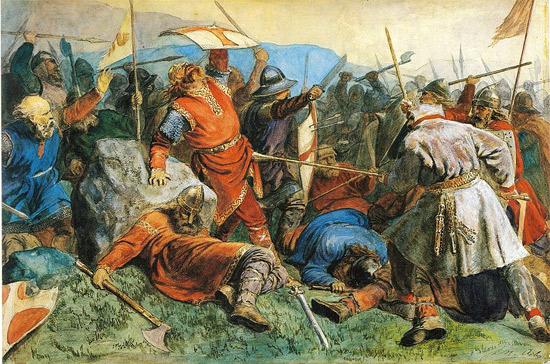
- the odd parallel that St. Olaf's battle in Norway is reenacted every July (really, I've seen it) and the Defeat of Jesse James is reenacted in Northfield every September.
- the use of the term "race" in this song--what did the term refer to in the 1920s when it could be applied to the Nordic race? What did it mean to Oles of the 1920s, many of them immigrants or children of immigrants, to sing about their race?
- the appropriation of the native American term Manitou for so many things on our campus that it seems to be a Norwegian word--is this use more or less salutary in an era when "race" has a different meaning and we (Americans in general and Oles in particular) are more attuned to the difficulties inherent in borrowings from one religious tradition to another?
- the very notion that there should be a college hymn as an early 20th century practice; how does this one compare to others?
- ritual use of this one: when do we sing it? why?
Wednesday, August 4, 2010
The Words or the Music of the Revolution
From Joseph J. Ellis, Founding Brothers: the Revolutionary Generation. (Vintage, 2000)
"With the American Revolution, as with all revolutions, differ
ent factions came together in common cause to overthrow the reigning regime, then discovered in the aftermath of their triumph that they had fundamentally different and politically incompatible notions of what they intended. . . . Taking sides in this debate [between the "twin goals" of individual freedom and equality (p. 16)] is like choosing between the words and the music of the American Revolution." p. 15
Ellis rightly identifies both the reality that in the service of a common goal, such as independence from England, persons with overlapping or even divergent values can form a strategic alliance and the way in which in the USA the tension inherent in such an alliance has been "not resolved so much as built into the fabric of our national identity." (p. 16) Knowing this allows us to pay attention to the ways it surfaces in the conversations we have among our selves and with others.
Freedom and equality: which is promoted? Which is threatened? Which value under girds polices and actions? Is it possible to have both? Is it necessary? The image of music and words seems to prefer both, but one can have instrumental music or poetry without the melody.
For example, and to the point of our interest in "Tea party" as a dense fact, which value is dominant in debates over taxes? Surely those who want lower taxes could be arguing for freedom from taxation. Does it follow, and is it so, that those who are willing to raise taxes are in favor of everyone paying an equal share? Or, is their position based on commitment to offering equal services for education, health care, transportation, and the like?
"With the American Revolution, as with all revolutions, differ
Ellis rightly identifies both the reality that in the service of a common goal, such as independence from England, persons with overlapping or even divergent values can form a strategic alliance and the way in which in the USA the tension inherent in such an alliance has been "not resolved so much as built into the fabric of our national identity." (p. 16) Knowing this allows us to pay attention to the ways it surfaces in the conversations we have among our selves and with others.
Freedom and equality: which is promoted? Which is threatened? Which value under girds polices and actions? Is it possible to have both? Is it necessary? The image of music and words seems to prefer both, but one can have instrumental music or poetry without the melody.
For example, and to the point of our interest in "Tea party" as a dense fact, which value is dominant in debates over taxes? Surely those who want lower taxes could be arguing for freedom from taxation. Does it follow, and is it so, that those who are willing to raise taxes are in favor of everyone paying an equal share? Or, is their position based on commitment to offering equal services for education, health care, transportation, and the like?
Subscribe to:
Posts (Atom)