Showing posts with label landscape. Show all posts

Tuesday, October 30, 2012

The large scale contours of American religion

In the midst of this first run at offering Religion 260, American Religion (non-seminar) I found my notes from the last time I offered something similar, spring 1984 at Wittenberg University in Springfield, Ohio. (That was just months after I'd passed my comprehensive doctoral exams.)  Immediately I noticed that in that earlier version of the course I was much more concerned, perhaps preoccupied, with insuring that my students absorbed many, many discreet pieces of information about American religious groups and their development. This time I'm much more interested in the patterns.  Or, one might say I'm more interested in plotting the contours of the landscape rather than focused on the individual data points.

Of course one can not plot the contours without the data points.  Perhaps this is a bit like the old discussion about trees and forests.  I'm now more interested in my students having a sense of the forest and being able to find their way among the trees.

Why?  I have a hunch that teaching religion 121, our introductory course in reading the Bible, and American Conservations has a great deal to do with my shift from pieces to patterns.   I'm relying less on students finding the material intrinsically interesting and am more concerned with how understanding what has been might help us understand what is.

And, I suspect that our current concern with religious pluralism raises questions about the past that push us toward the forest rather than the trees.   As we move through the 'text book' and more focused scholarship I find myself noticing connections and comparisons that had never occurred to me before and considering lines of questions that are novel to me.  For example, how do various groups and individuals expect to gain access to the sacred?  Can we trace developments and chart various options?  There is the classic Protestant expectation that this comes through reading the Bible, but also Deist reliance on reason not harnessed to scripture.  And how to compare the  state of revivalist ecstasy to the ritually indued trance of Mother Ann's work or the Ghost Dance?

Nothing better than new ideas! 

Sunday, April 22, 2012

deep maps

"How a world is imagined and lived in begins with 'maps' far more profoundly ingrained that those of the cartographer.  It includes a deep sense of home and of the familiar places likened to it.  It also includes a sense of the distant and unfamiliar.  Mapping the known world has always included, at its periphery, the unknown world, terra incognita, which the imagination may conceive as shadowy and frightful or as golden and glorious."  Diana Eck, India: A Sacred Geography

Paul Bunyan & Babe the Big Blue Ox: Bemidji, MN
I'm finding this book fascinating for what it is teaching me about India, for what it is showing me about the relationships between human beings, our collective identities, and landscape, and for what it is causing me to wonder about these dynamics in North America where our shared mythology is so young.  Indian identification of sacred places (fords, crossing points), of dwellings of the divine, and routes of pilgrimage are many centuries old.  The mythology and the landscape are intricately tied by repeated rituals and long memory.

It may be that individual Americans and perhaps their closest family and friends have a few decades or even a century of layering, but as a people our mythological mapping is more thin than deep.  Nonetheless, I'm curious about what there is and how it is developing.  How might family vacations to national and state parks be understood within this framework?  Do historic landmarks play a part?  What of those odd, local markers and annual town festivals, like the Defeat of Jesse James Day here in my town?  What would be learned from paying serious attention to these roadside attractions?

Thursday, March 8, 2012

Landscape or People?

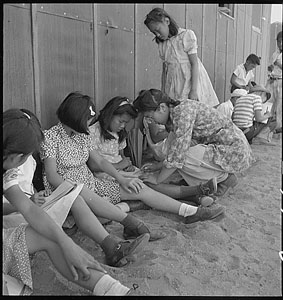
Meg Ojala helped us with reading photographs of the Japanese internment camps, especially with understanding what Dorothea Lange and Ansel Adams each brought to their work.  Three key differences:

1) Why each one was there: Lange was commissioned, Adams was there on his own.
2)  Technical skill and style: Lange was the less technically adept; she used a hand-held large (or maybe medium) format camera; she got close to the subjects.  Adams was more of a careful technician; he used a tripod; he allowed the subjects to prepare themselves rather than attempting something akin to "candid" shots.
3) Their larger body of work:  Lange had already made many photos of people as part of her earlier documentary work.  Adams made his reputation as a landscape photographer in the linage (sort of) of great western landscape painters.

All this led me to ponder a question:  which subject matter is best suited to portrayals of America?

The national parks, we've learned, were established at least in part as a statement of patriotic pride.  While the USA might not have a long, magnificent cultural history like Europe, the parks demonstrated that it did encompass monumental landscapes.  On the other hand, can the landscape without the people tell us much about the culture that is definitive of the nation?

And that of course sends me back to my interim course in Greece and Turkey where we talked about taking photographs and what we include and exclude.  More often than not the tourist post-cards are photos of buildings (or ruins of them).  Some are of spectacular landscape, though often as background for the human construction.  Seldom are people included.

Now I'm back to those photos Lange took.  (The one here is hers.  More via the link in the first paragraph.)  Some observers suggest that she portrays degradation in contrast to Adams who shows the people's dignity.   When I look at her photos, I see human vulnerability and am moved.  But, I wonder if that sort of intimacy is more than what is generally desired when we are looking for images to convey something large about a nation.  Perhaps we default to landscape or buildings because those are less personal.

More to ponder.

Wednesday, August 18, 2010

Free spaces

Back from ten days in southern California including several in a part of the west San Fernando Valley developed about the time I was born.  Walks around the neighborhood gave me opportunity to see how the classic suburb has developed: the landscaping in some yards is out-of-control, way beyond what anyone anticipated; most houses are altered so that the original similarity is hidden behind new garages, changed roof lines, expanded pavement, distinctive plantings, and the like.  The basic grid pattern, interrupted by a few curves, is there, but it provides a big structure that one follows to other neighborhoods.  Inside this one, there is something closer to cozy.

I know that the ideal of the fifties was a sort of free life that included a single family house, a car, a citrus tree in the yard, etc.  We'll read more about this is later chapters of Jim Cullen's American Dream: A Short History of An Idea that Shaped a Nation (Oxford, 2004).  It is a dream that is easy to deride as trivial or shallow.  What I saw reminded me that over time people put down roots and make a place their own.  Also that over time cracks can appear.  In fact, since I was near Northridge, many of these houses were rebuilt following a major earthquake about 20 years ago. 

Another foundation of the Southern California suburb was the automobile.  (Foreshadowing Am Con 201 and the model-T Ford.)  Nonetheless, I spent a great day taking the growing LA public transit system from the West Valley to Union Station downtown and then to Venice Beach.  Yeah, it took all day and I got to see lots of people.  And I was not caught in a traffic jam as I was the next day when my brother and I drove to SanDiego, down the 5 at about 30 miles an hour.

Of interest to us: a 60+ woman on the Orange Line rapid transit bus.  She told me that she would never have known about this great system if she had not had had her driver's license revoked.  Then she mentioned that she is interested in learning more about how government works.  "All those John Birch folks," she said, "understand all of that."  I pointed her toward the League of Women Voters.

so . . . freedom to belong in a space and make it your own; freedom of movement; and freedom to participate.  How do these line up with Foner's categories?

DeAne

Thursday, August 5, 2010

compass point

My friend Marty Stortz, who writes a blog titled the Progress of Pilgrimage, has recently moved to Minneapolis.  In today's post she evokes the image of orientation.  That has to do with using a compass.  Moving through space, wilderness, or even campus using compass rather than a map requires a different sort of attention to landscape and landmarks.  Perhaps navigating by compass allows us to explore and discover in ways that we don't when following map-quest generated directions.


This pondering takes me back to my first and second posts and to the purpose for these blogs.  Surely their purposes include to identify the cardinal directions that orient us and to record landmarks along the way. The course theme, "Freedoms," is a sort of "true North" that helps us make our way through the readings and conversations.  Whatever we encounter we will observe with one eye focused on Freedom; but, we won't forget its twin, that is equality. Today I won't spin this analogy out too far.


If I were keeping an old style common place book, I would pick up my best fountain pen to carefully copy out this bit of Mary Oliver's poem "Sometimes" in my most legible hand writing because these four lines are like a trail marker for a life of learning.  Here I must content myself with purple "ink."

4. 
Instructions for living a life:
Pay attention.
Be astonished.
Tell about it.

[I must look for the complete citation at home.]

Thursday, July 22, 2010

Perceptions, Places, Pumpkins, Prairies

This morning I've been reading the materials on place. This is a topic I'm very interested in. (Last January my interim course explored the notion of sacred place in Greece and Turkey.) And I'm thinking about how to write the assignment about St. Olaf as a place. These materials sparked lots of ideas: general ones and others specific to our class.

In Stilgoe's "Jack-O-Lanterns to Surveyors," the discussion of termini brought to memory the markers in the Athens agora that declare its edges and reminded me of the new gate at the bottom of the hill. It declares St. Olaf's location while prohibiting entry unless there is an emergency. Shall we have a pumpkin carving this October to recall this old way of marking boundaries?

From the same source: "The evolution of mathematical surveying paralleled, and perhaps encouraged, the changing landscape perception of the common folk." p. 54 Yes, I agreed, recalling the book, Measuring America, and the impact of a grid pattern on former prairie lands when those were divided into sections and farms as American examples. Also--a radio story I heard that reported that women are more attentive to landmarks to orient themselves in space and men to more abstract factors. (Can that be true?)

In regard to our class, and at the beginning of our work together, I also noted that this may also be true about learning. The evolution and adoption of new technologies encourages and parallels changing perceptions of community, of freedom, of learning. This is worth paying attention to. A small example: either copying out a quotation in longhand or typing it into this blog forces me to read every word and to encounter the sentences with my hands in ways that running a highlighter over the text does not. Or: what of the difference between reading a book, a photocopy, or on-line? Does the tactile experience matter? (And I admit to missing the possibility of looking at the card to see who else held a book and read it. See Billy Collins' Marginalia.) Another: 'conversing' digitally removes much of the sensory experience of doing so in a room together. I don't hear the sound of voices. There is no overlap of one interrupting another. Little possibility of laughter. No colors from clothing. Does the electronic mode of communication dis-embody knowledge? Does it diminish our community? So . . . . the BIG question . . . . how does the technology of conversation and study influence the character of our learning and community?

And, of course, it is always salutary to be reminded of Jonathan Z. Smith's aphorism: "The map is not the territory." This despite how valuable it is to have a map!