Showing posts with label technology. Show all posts

Friday, July 6, 2012

getting cool

St. Paul, MN July 1935
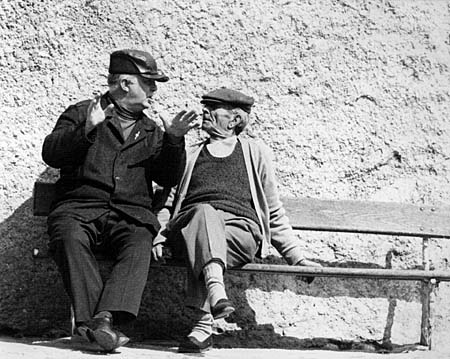
A radio news story reports that in a major American city efforts to restrict the visible presence of homeless people (notice: not to address the fact of homelessness) include laws prohibiting sleeping in public, eating in public, and feeding people in public.  The public policy issues related to how we address homelessness deserve to be commented upon, but that is not the point of this post.  Rather, in the midst of an intense and prolonged heat wave this story recalls how people coped with heat in the pre-air conditioned era: they slept outside, sometimes in public places, they jumped in bodies of water, they wrapped themselves in damp sheets.  Generally hot weather drove people into places where they saw more of each other rather than into the refuge of their own houses.  Now the cost of getting cool is not only a higher utility bill and the environmental side-effects of increased energy usage, it is also reduced social contact.

I write this, of course, sitting in my newly air-conditioned office in a newly refurbished 130 year old building.  And I don't wish to sleep outside with the mosquitoes.  So I wonder how my predecessors reacted when the days and nights were hot.  Did they keep working as if the temperature were mild?  Did they stop often for a long drink of water?  Did they give up cooking and eat only raw vegetables?   Did they repair to the Canon River or Heath Creek for an afternoon of wading and splashing?  Were those the days when Boe sat in Rolvaag's back yard smoking cigars and planning for a Greater St. Olaf?

Saturday, May 5, 2012

Technology that promotes social captial

"covered dish" for bringing a meal
My students know that I tend to be skeptical about the degree to which electronic technology actually promotes human good.  I recognize the potential, but I also see the down side.  So it seems honest for me to acknowledge that CaringBridge and FoodTidings.com appear to be uses of technology that do promote social capital.  Both depend upon prior relationships and foster them in service of sharing news about a person well-loved and of providing meals and other help.  Perhaps by making that person's network of friends visible, these programs even stimulate new relationships and expand community.  Seems like an interesting topic for further research.

Sunday, April 22, 2012

the illusion of conversation in sips of connection

"WE expect more from technology and less from one another and seem increasingly drawn to technologies that provide the illusion of companionship without the demands of relationship. Always-on/always-on-you devices provide three powerful fantasies: that we will always be heard; that we can put our attention wherever we want it to be; and that we never have to be alone. Indeed our new devices have turned being alone into a problem that can be solved." 

Thanks to Beth for sending along the LINK to this piece in the New York Times by Sherry Turkle, wise student and observer of human interactions with and use of technology. Turkle notes that real conversations, that are the stuff of real relationships, take time and encourage reflection.  These can be enhanced by instant modes of communication, which she designates as "sips," but she asserts those texts, tweets, and FB messages do not substitute for relationship and can be used to avoid genuine solitude.  If the technology has limited effectiveness for individual relationships, one wonders if the limits are even more limited for building community?

Notice that limited effectiveness does not imply no effectiveness, only that some types of interaction require time and physical presence.  In this regard a resident college offers its students a precious opportunity to live, study, eat, and converse in real-time, face-to-face over an extended period of time.  That this most often takes place when students are in their late teens and early twenties probably magnifies the benefit.  Perhaps it might even foster a desire to seek out other communities once they graduate from college life.

Tuesday, April 3, 2012

"Like" it on Facebook

The suggestion appears in so many places.  "Like us on Facebook."  Every posting (almost) offers the possibility to like what one has just read.  I find myself liking this, a bit to my surprise.  Why the positive response?

1)  Grammatical reason:  like is after all a verb.  I like that the word like is being used in a way close to what I take to be its central meaning, one that indicates approval, perhaps even affection.

2) Attitudinal reason: like indicates a positive response.  I like that I'm being offered the opportunity to express approval, perhaps even affection, without the corresponding negative options.  Of course I could type those in, but the default for response is "like."  Maybe this is a bit like the adage, "If you don't have something good to say, don't say anything."  Nonetheless, I like that I'm being encouraged to express my approval, delight, appreciation, or other positive responses.

NB: I do not, by this approval of liking, mean to suggest that there are no situations in which disapproval or protest is necessary; only that casual negative response is not healthy for individuals or conducive to community life.

Thursday, July 22, 2010

Perceptions, Places, Pumpkins, Prairies

This morning I've been reading the materials on place. This is a topic I'm very interested in. (Last January my interim course explored the notion of sacred place in Greece and Turkey.) And I'm thinking about how to write the assignment about St. Olaf as a place. These materials sparked lots of ideas: general ones and others specific to our class.

In Stilgoe's "Jack-O-Lanterns to Surveyors," the discussion of termini brought to memory the markers in the Athens agora that declare its edges and reminded me of the new gate at the bottom of the hill. It declares St. Olaf's location while prohibiting entry unless there is an emergency. Shall we have a pumpkin carving this October to recall this old way of marking boundaries?

From the same source: "The evolution of mathematical surveying paralleled, and perhaps encouraged, the changing landscape perception of the common folk." p. 54 Yes, I agreed, recalling the book, Measuring America, and the impact of a grid pattern on former prairie lands when those were divided into sections and farms as American examples. Also--a radio story I heard that reported that women are more attentive to landmarks to orient themselves in space and men to more abstract factors. (Can that be true?)

In regard to our class, and at the beginning of our work together, I also noted that this may also be true about learning. The evolution and adoption of new technologies encourages and parallels changing perceptions of community, of freedom, of learning. This is worth paying attention to. A small example: either copying out a quotation in longhand or typing it into this blog forces me to read every word and to encounter the sentences with my hands in ways that running a highlighter over the text does not. Or: what of the difference between reading a book, a photocopy, or on-line? Does the tactile experience matter? (And I admit to missing the possibility of looking at the card to see who else held a book and read it. See Billy Collins' Marginalia.) Another: 'conversing' digitally removes much of the sensory experience of doing so in a room together. I don't hear the sound of voices. There is no overlap of one interrupting another. Little possibility of laughter. No colors from clothing. Does the electronic mode of communication dis-embody knowledge? Does it diminish our community? So . . . . the BIG question . . . . how does the technology of conversation and study influence the character of our learning and community?

And, of course, it is always salutary to be reminded of Jonathan Z. Smith's aphorism: "The map is not the territory." This despite how valuable it is to have a map!